
Rewards Capping
Set reward limits to control your program expenditure
You can limit how many rewards a member can get over a given time period. This serves as an automatic spending control that helps your incentive and loyalty program stay within budget.
Caps are cyclical and can be applied on a rolling basis (e.g. over the last 120 days) or over a calendar period (i.e. every month, every quarter or every year). You can create caps that limit the number of rewards a member can redeem, either program-wide or specific to certain rewards.
Redemption reversions are taken into account so that those rewards no longer count against the member's cap.
Creating a Cap
From the Programs tab, enter the program you want to create a cap for. On the Caps related list, click New.

Enter a name and description. Then, under What do you want to cap?, choose Quantity of Rewards redeemed.
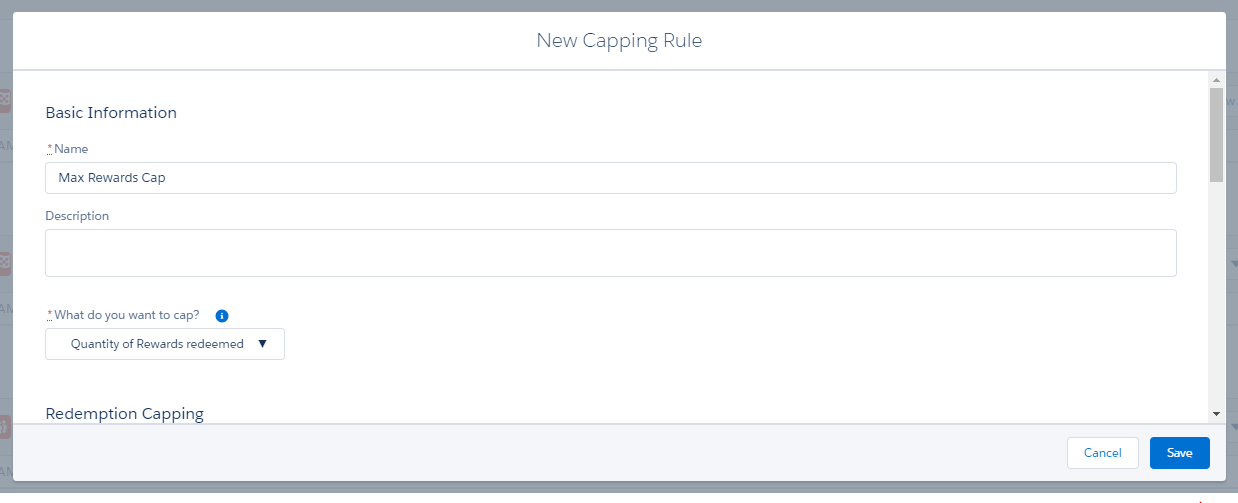
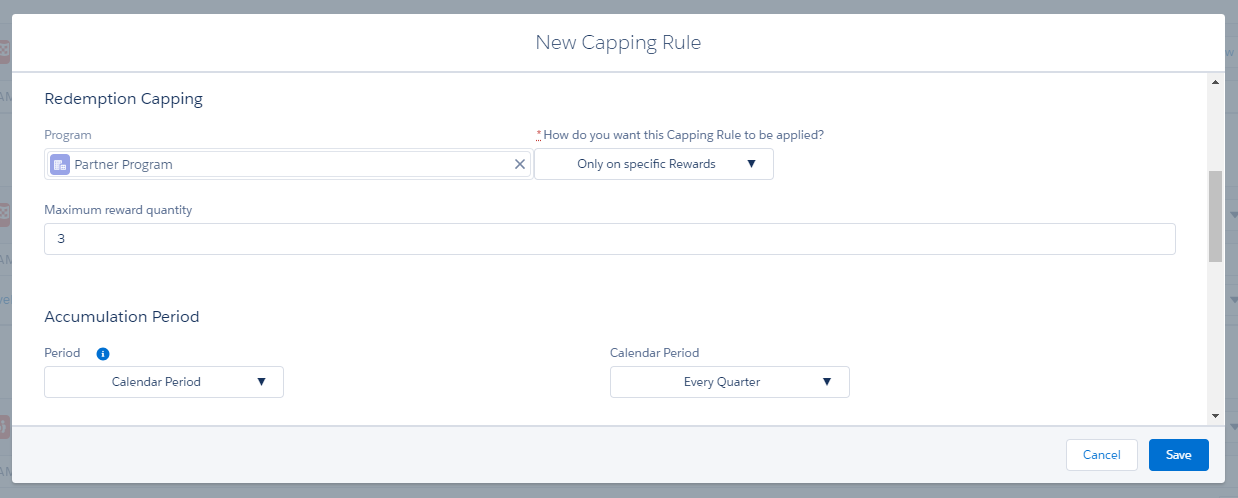
Select whether you want to apply the cap throughout your entire program or only on specific rewards. Then, under Maximum reward quantity, enter the highest number of items you want a member to be able to redeem in a given time period.
Next, specify the time period you want the cap to cover. You can use a rolling period—that is, a set number of days or months up to today—or a calendar period, such as Every Month, Every Quarter or Every Year.
We don't recommend it, but if you leave the accumulation period on None, the limit won't be renewed or lifted while the cap is active.
The rolling period limits rewards redeemed over a specified number of days or months prior to today, meaning that the number of items counting toward the limit is continuously updated to reflect only the redemptions that occurred in the last x days/months.
The calendar period, on the other hand, automatically follows the months, quarters and years on the calendar to determine which redemptions count toward the limit (e.g. March 1st - 31st for Every Month, January 1st - March 31st for Every Quarter, etc.). At the end of the calendar period, the reward limit is reset.
Now, you can select whether you want to track your cap for reporting purposes. This means that the first time a member exceeds the cap during a capping period, a Cap Audit (FieloPLT__AuditCap__c) record is created. Then, in the Analytics folder of Salesforce Reports, you can access our Reward Capping History by Member and Reward Capping History by Program reports to get a full view of which caps were exceeded, by whom, etc.
If a member exceeds a cap multiple times during a capping period, only the first instance will be recorded for reporting purposes.
If you chose to cap only on specific rewards, next select which rewards you want the cap to apply to. If you choose multiple rewards, all of them will be put into the same "bucket" subject to the limit you specified above.
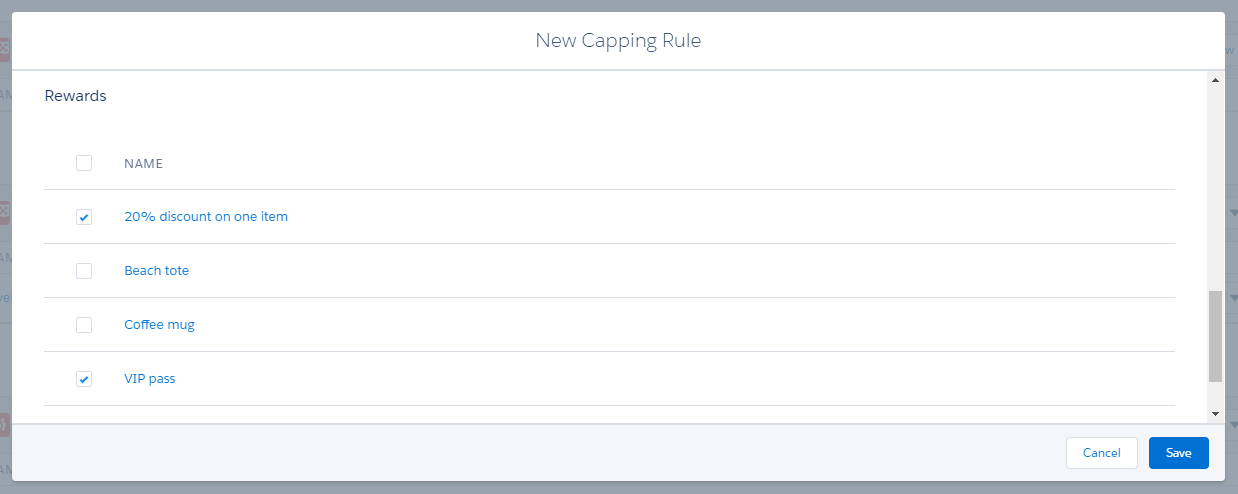
(Available only for caps on specific rewards)
Otherwise, if your cap is for the entire program, you can use segmentation in order to apply it only to certain subset(s) of members. Leave the right-hand list blank if you want your cap to apply to all members.
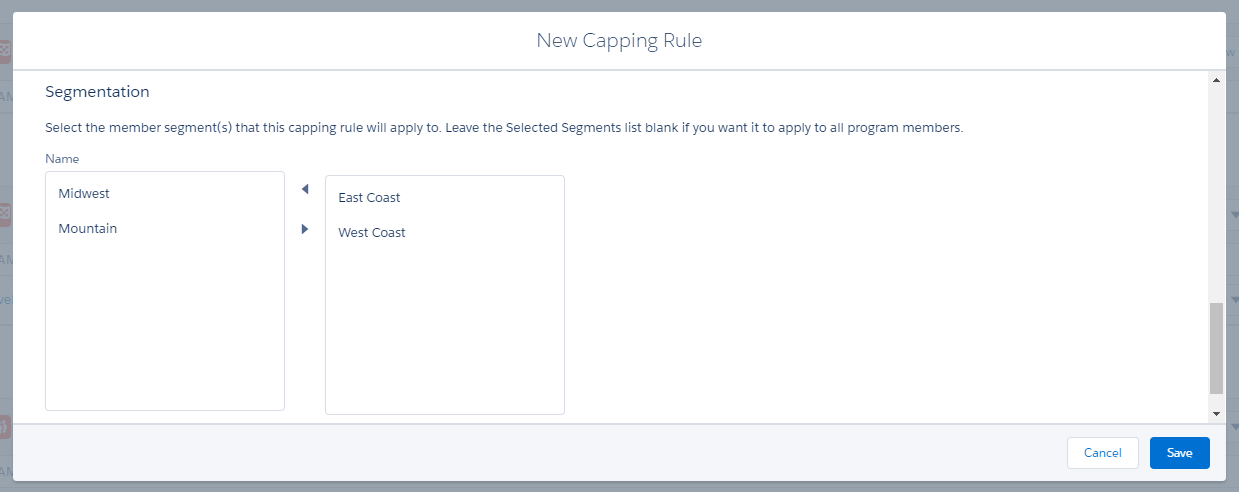
(Available only for caps on entire program)
When you're ready, click Save.
Activating a Cap
Once you've created a cap, it will be saved with the status of Draft. In order for the cap to go into effect, you'll need to activate it. Keep in mind that once you activate a cap, you will only be able to edit the Name, Description, Maximum reward quantity, and Track for Report fields.
On the Caps related list, click on the line corresponding to the cap and choose Activate / Deactivate.
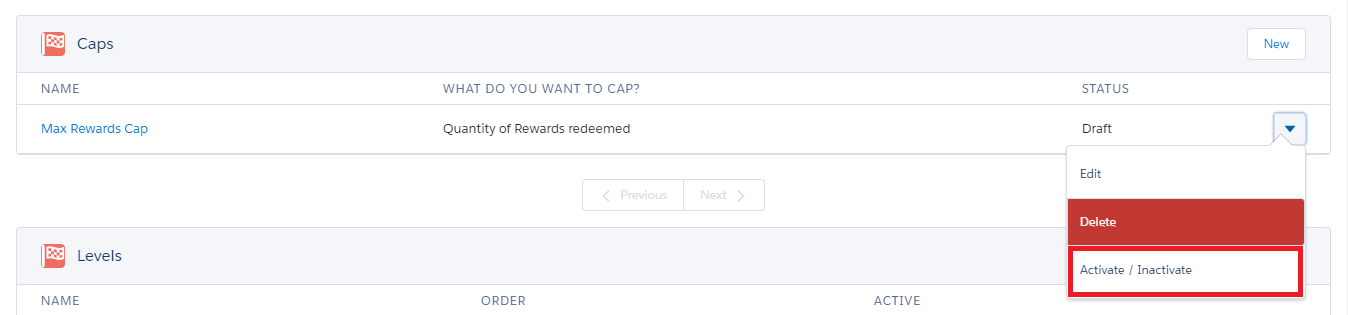
This is also how you can edit or deactivate your cap later on.
Updated over 1 year ago