
Levels
Create and manage Member tiers
Levels rank members by including them into different groups (e.g. Bronze, Silver, Gold). Members can influence their level by engaging with the program and performing incentivized behaviors.
Creating a Level
Start by going to the Outcomes tab and select the program you want to create a level for. Go to the Levels section and click New Level.
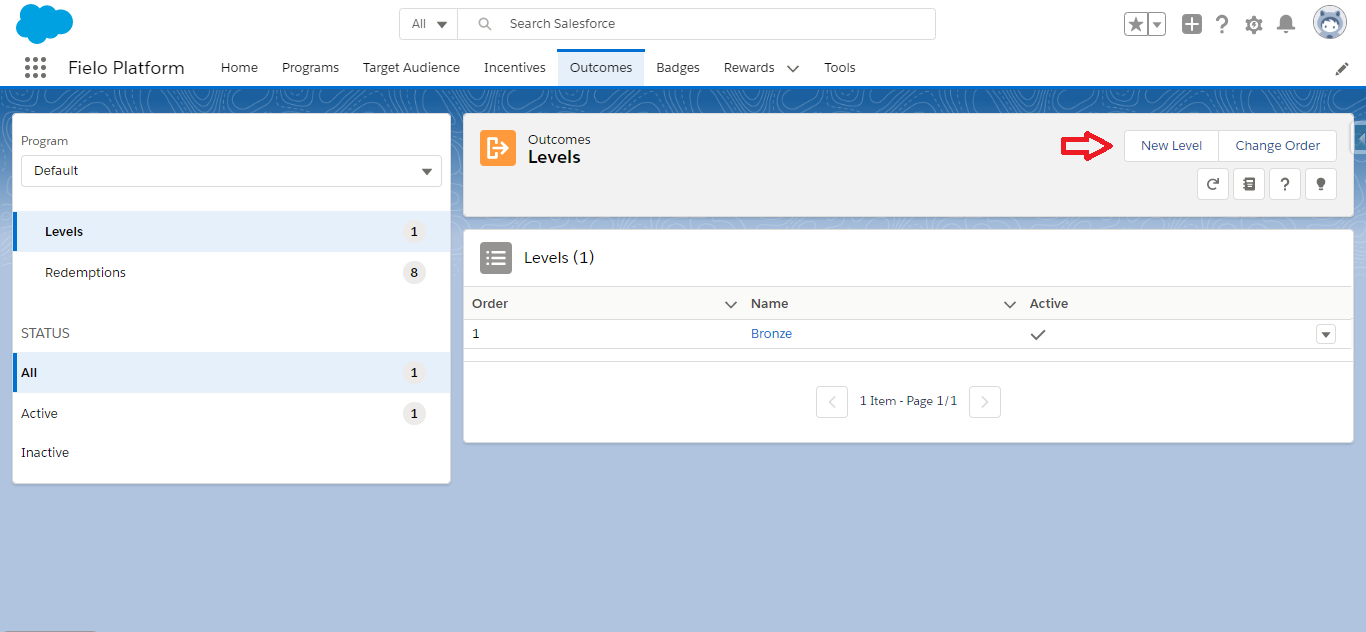
Program - Levels
Enter an appealing name for your level.
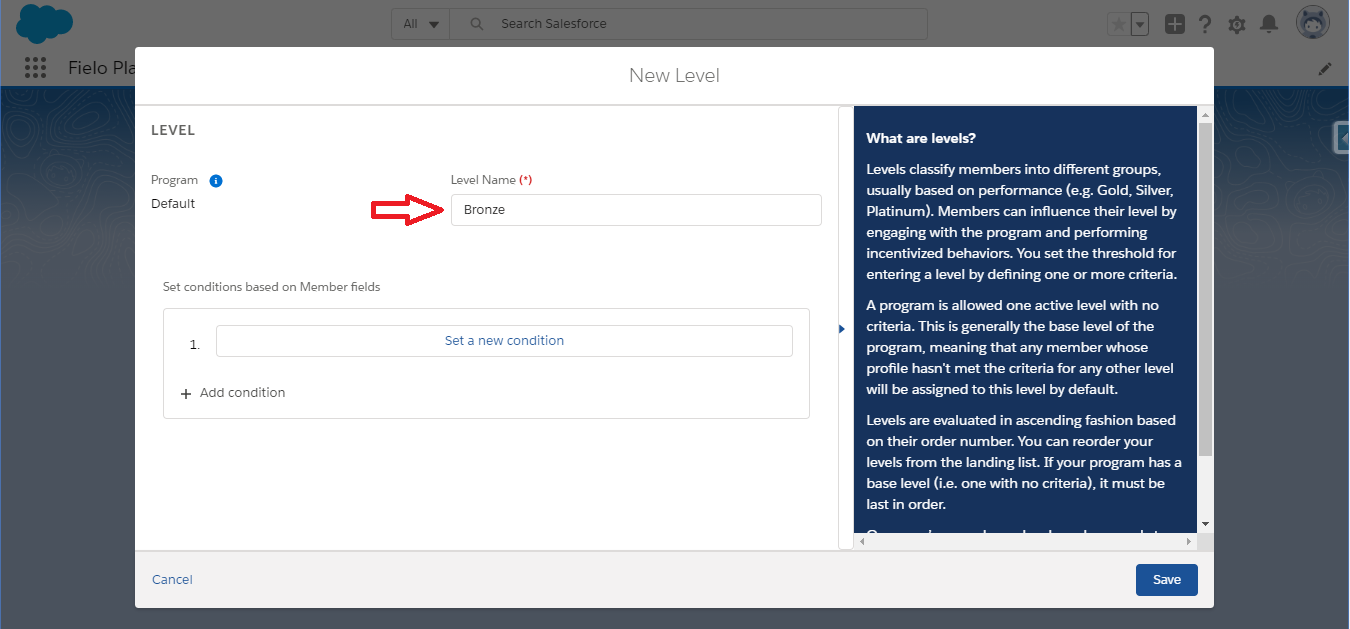
Create Level - Level Name
Now, in Filter Criteria, we'll specify the criteria for your level. These are how your level will be defined.
There are two types of conditions for criteria, Add Condition and Add Related List Condition. You can add as many conditions as you'd like from both types and, if necessary, it's possible to edit it later or even delete it.
-
Add Condition - Allows you to define what criteria need to be met so that the member is added to the level.
-
Add Related List Condition - Allows you to define criteria over a group of records of member activities. This means it's possible to create a level over member related lists such as: Member Badges, Events, Transactions, Challenge Member, Mission Member, Member Courses, etc. For example, a level could be related to the number of badges that a member has.
Each criterion takes the form of a logical or mathematical comparison between the value of a field and either a fixed value or the value of another field. For example, you could compare a member's badges count with either the fixed value 10 or the value of some other numerical field.
For numbers, comparison operators include "Equals", "Greater than", "Less than", "Greater or equal", etc. In the case of text, the comparison can be to see if the values are the same ("Equals") or different ("Not equal"), or if the second value contains the first value ("Contains") or not ("Not contains").
A program is allowed one active level with no criteria. This is generally the base level of the program, meaning that any member whose profile hasn't met the criteria for any other level will be assigned to this level by default.
Let's walk through an example to see how to apply criteria:
Let's look at an example to see how it works when usingAdd Condition:
- Under Field Name, select the Points field
- Under Operator, choose the operator that will compare the field with your criterion value. We will use Less or equal.
- If you want to compare the value of the field in Field Name with the value of another field, select Dynamic value. Otherwise, leave it as Fixed. We will be leaving it fixed for this example.
- Under Value, enter the number or text value you want to compare with the field in Field Name or, if Field is , choose the field whose value you want to compare with the field in Field Name. We will put "1,000" in the Value field.
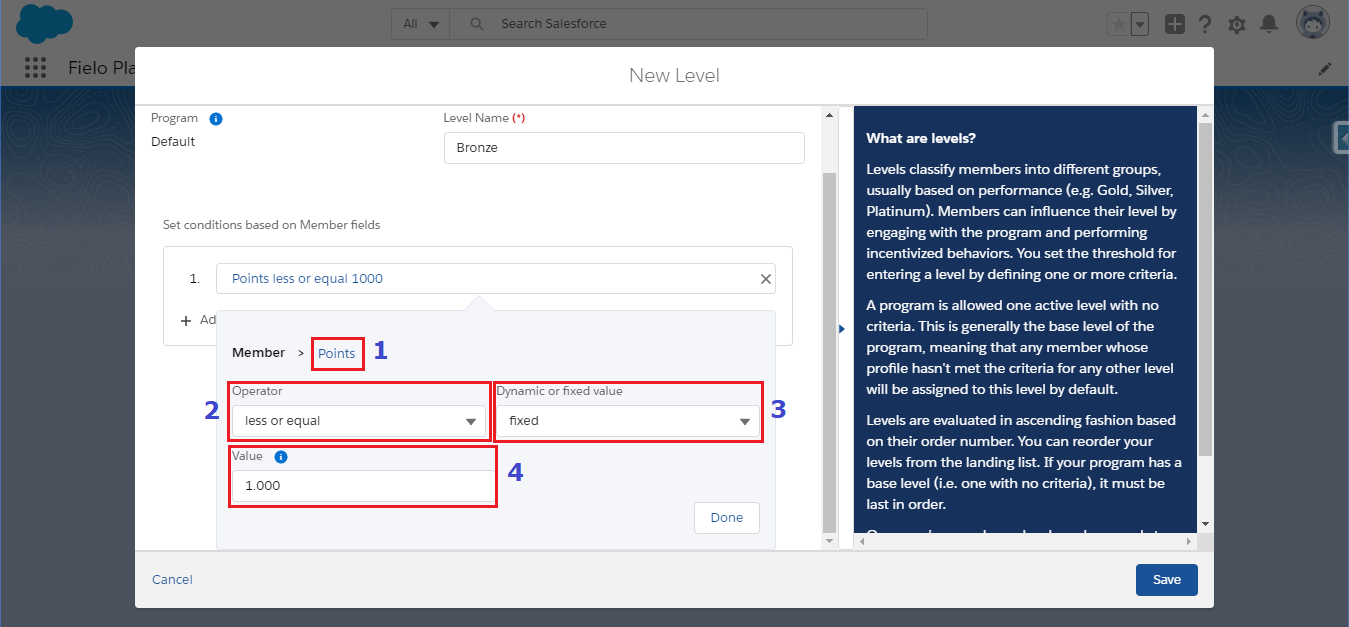
Create Level - Criterion
Let's look at an example to see how it works when usingAdd Related List Condition:
- Under Field Name, select the Badge Member > Badge > Badge Name field.
- Under Operator, choose the operator that will compare the field with your criterion value. We will use equals.
- If you want to compare the value of the field in Field Name with the value of another field, select Dynamic value. Otherwise, leave it as Fixed. We will be leaving it fixed for this example.
- Under Value, enter the number or text value you want to compare with the field in Field Name or, if Field is , choose the field whose value you want to compare with the field in Field Name. We will put "Top Seller" in the Value field.
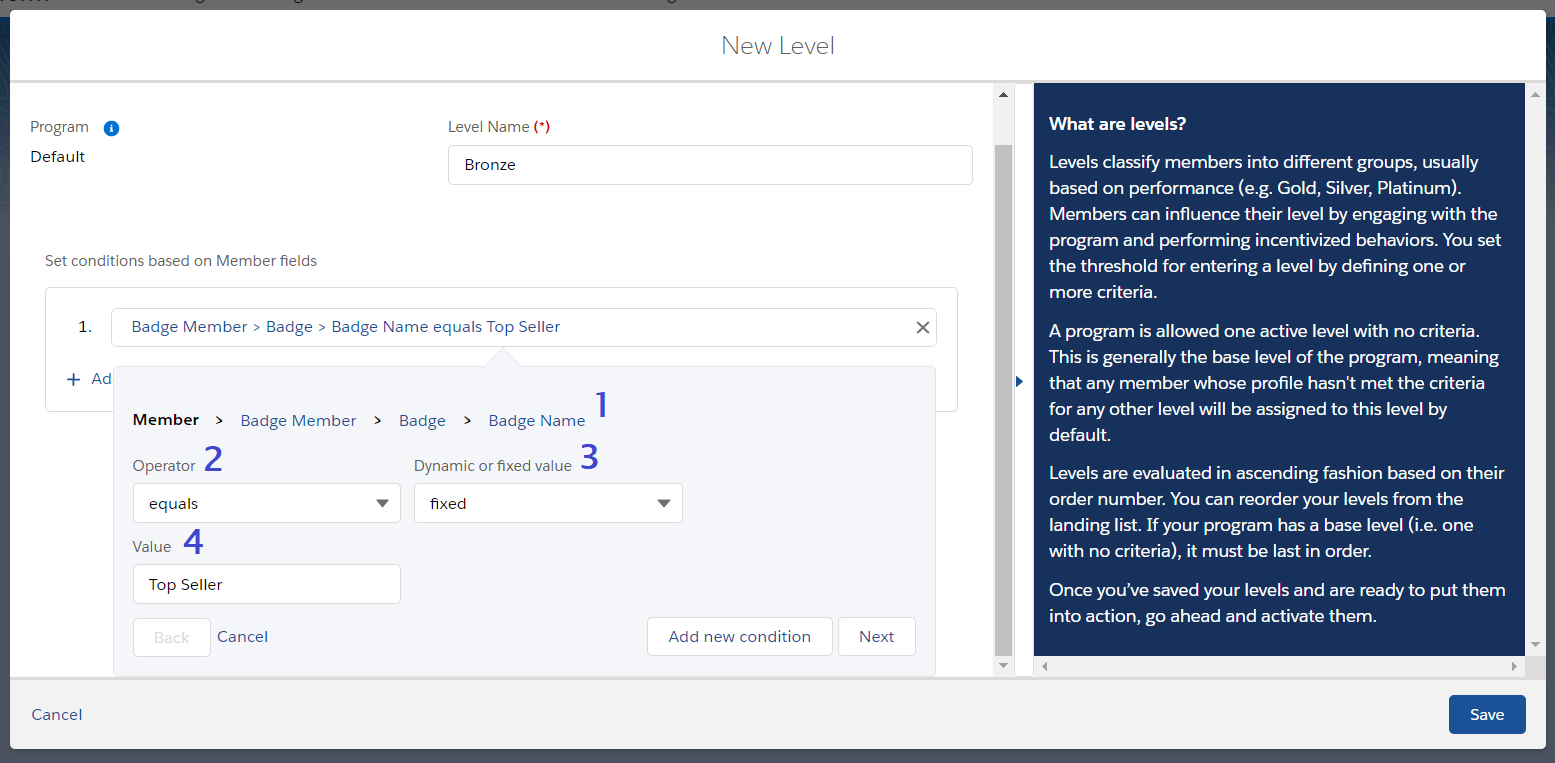
Create Level - Criterion
Now you will need to set how to aggregate the matched records, it can be either Count the number of records that met the conditions or Sum up a field over all of the records that met the conditions.
We will set it to COUNT with a greater or equals Value of "1", so that the Member has to have at least 1 Top Seller badge to accomplish the criteria to become Bronze Level.
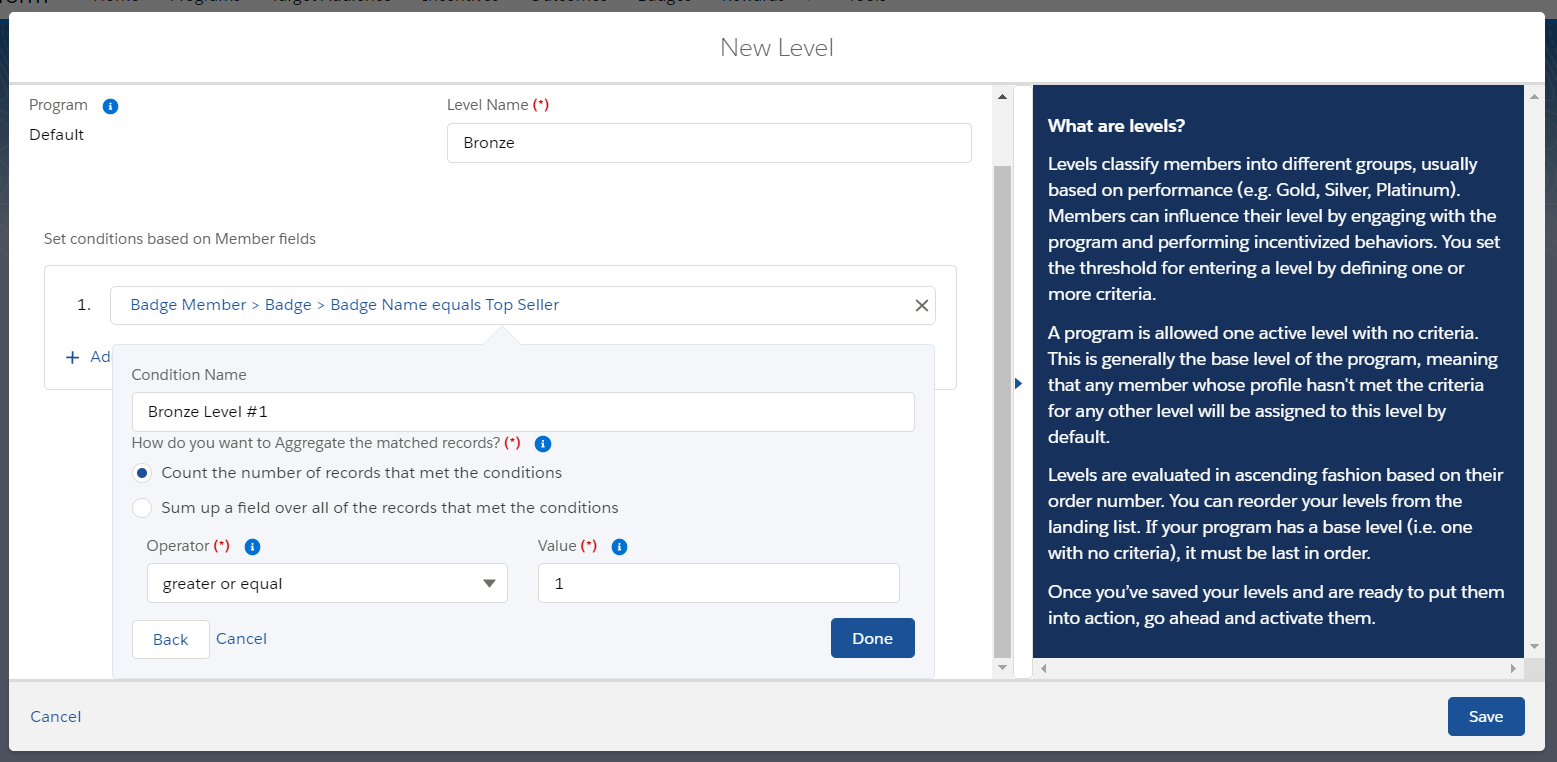
Defining the level's criteria
AggregationThe count option is generally used when you want to specify the number of times the member has done something or the quantity of redemptions, rewards, badges, etc. they have. Sum is better used to summarize a member field's amount (e.g. invoice amount).
Add another criterion
To add another criterion, click Add condition or Add Related List Condition and follow the same process to define it. You can remove a criterion by clicking .
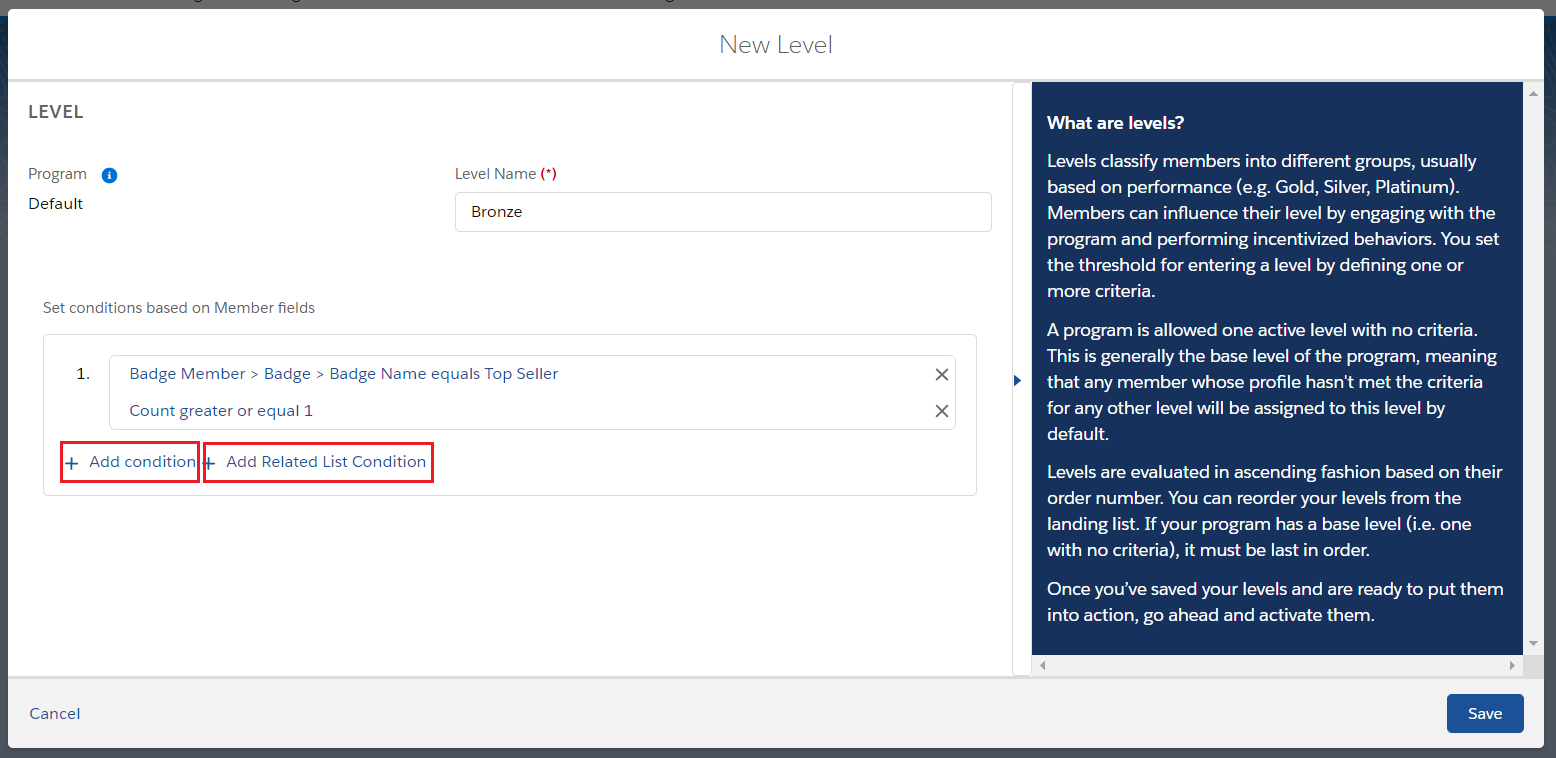
Create Level - New Criterion
When you've finished adding and defining criteria, you can then specify how they are evaluated via Match Criteria:
- All conditions are true means that all of your criteria will need to met for a member to be included in the level.
- Any condition is true means that a member whose profile meets any one of your criteria will be included in the level.
- The following expression is met allows you to specify more complex criteria prioritization. If selected, you must enter a formula with logical operators and your criterion numbers. For example, if you enter
(1 AND (2 OR 3)), a member who meets your first criterion and your second or your third criterion (or both) will be included in the level.
When entering a formula, make sure to add up to two conditions between the same parenthesis. For example, instead of (1 AND 2 AND 3), use ((1 AND 2) AND 3).
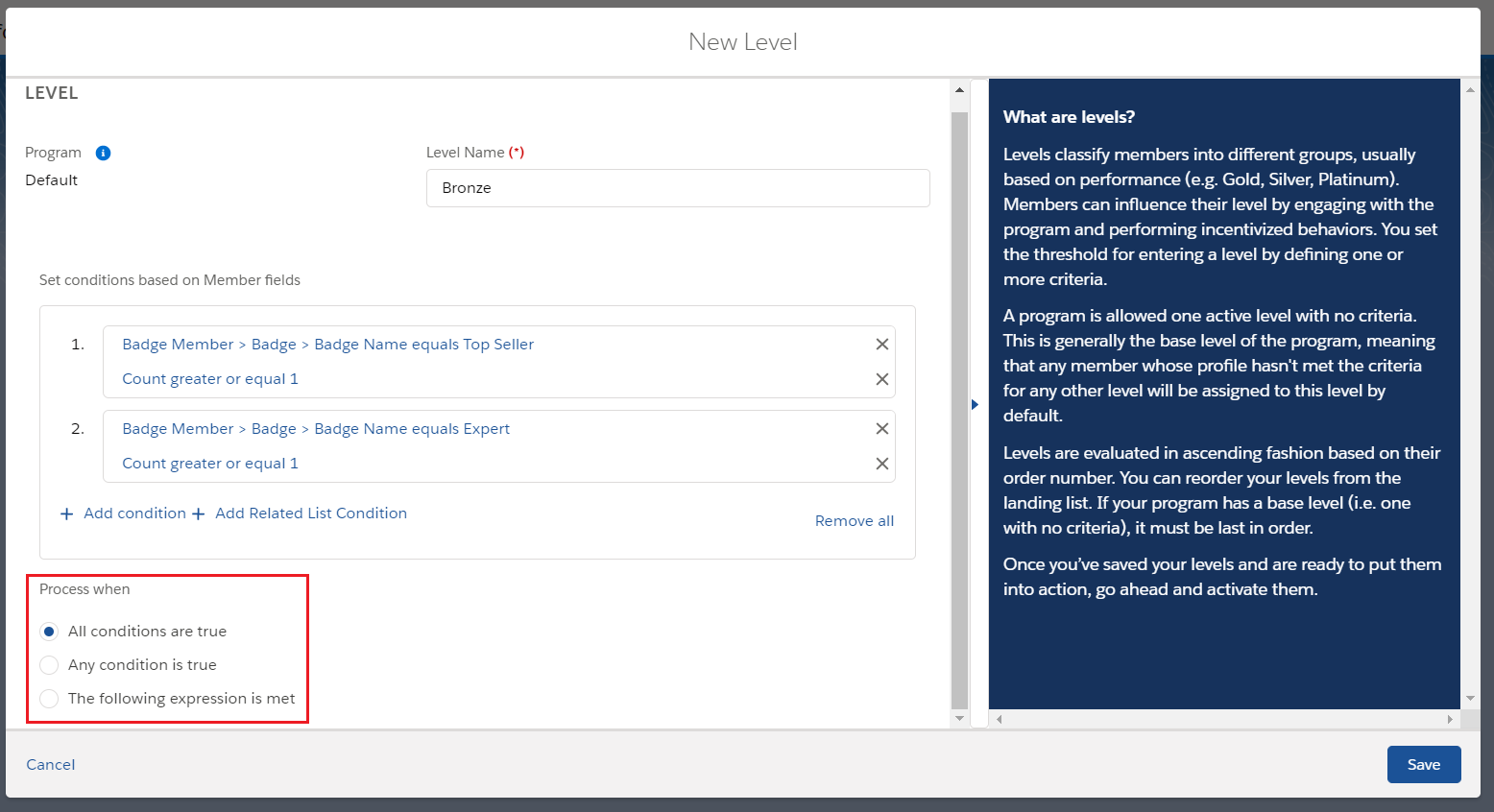
Create Level - Match Criteria
Once you're happy with everything, click Save.
Activating a Level
Once you've created a level, you'll need to activate it to make it available for use.
Click the level you have just created and hit the Activate button in the upper-right side of the screen.
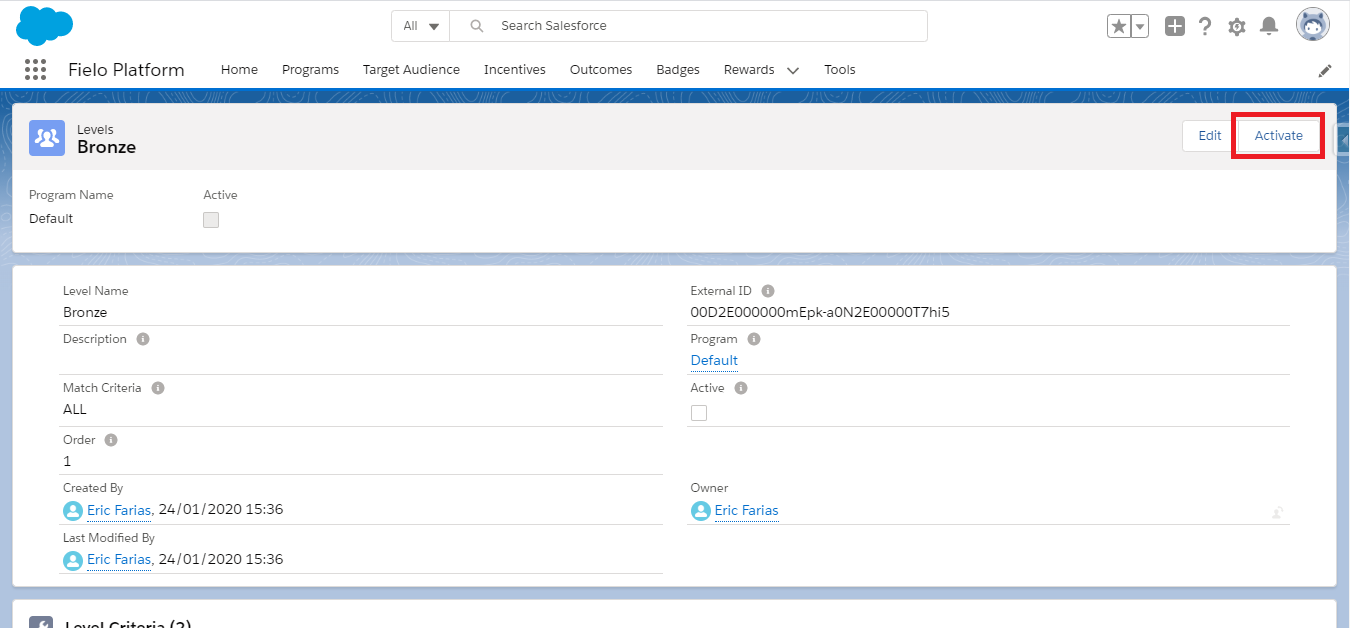
Edit Level
Changing the Level Order
The level order determines which level is evaluated first, second, third, etc. when Fielo assigns levels to members. Imagine the following level structure:
| Level Name | Criteria |
|---|---|
| Platinum | Points Balance ≥ 1,000 |
| Gold | Points Balance ≥ 500 |
| Silver | Points Balance > 100 |
In the above example, you would want to make the Platinum level Order 1, so that a member who has more than 1,000 Points would be assigned Platinum rather than Gold. Then, with Gold at Order 2, any member with over 500 but less than 1,000 Points would be assigned to Gold. Silver, which in this example is the base level, would have to be evaluated last (in this case, Order 3) because it has the easiest criteria to achieve: to have more than 100 Points.
In other words, if the member doesn't apply to the Platinum level, then they are evaluated to the Gold level. If they don't apply to the Gold level either, they will be evaluated to the Silver level. As soon as the system confirms that the member applies to a level, the member is not evaluated to the next level in the order.
Now, let's see how to reorder your levels. From the Outcomes tab, in the Levels section, click Change Order. You'll be taken to the Reorder Levels page. Here, you can drag and drop your levels into the preferred order.
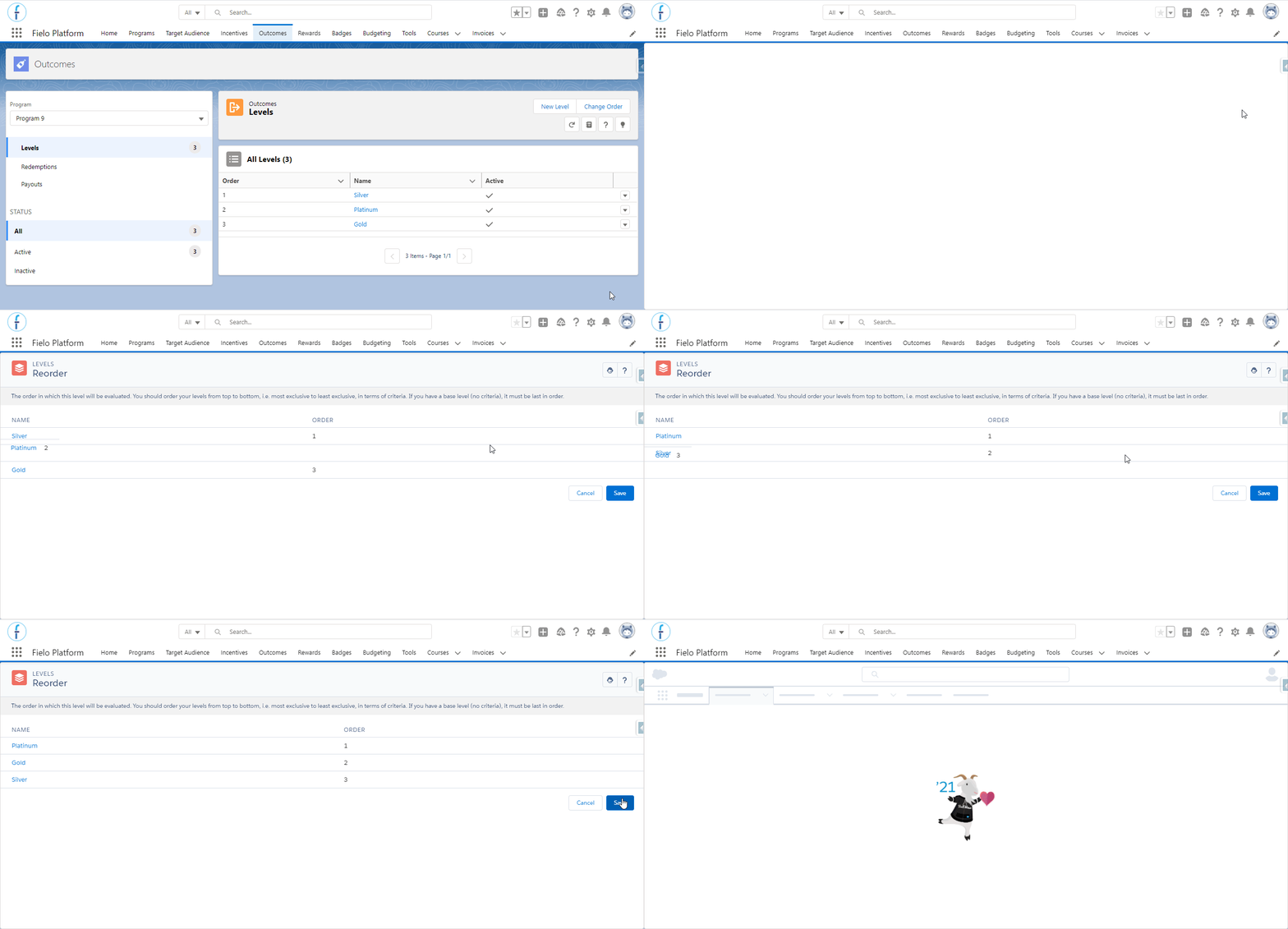
Reorder Levels
When you're ready, click Save.
Level with no criteriaRemember that you can have only one level with no criteria in your program (i.e. a base level) and, if you have one, it must be last in your Level Order.
Recalculating Levels
Levels are automatically assigned to members in the following conditions:
- When the member is created.
- When the batch runs automatically.
- When you run the batch manually.
The Salesforce scheduled job related to the Level batch - the one created along with the FieloPLT package installation, levelAssignmentJob - runs automatically only once a month. However, you can create another one in order for the batch to run more frequently if you wish: see how here.
If you want to manually run a batch, go to the Program tab and click to select Batch Management. On the Batch Execution page, in the row named Assign Levels to Members, click Run.
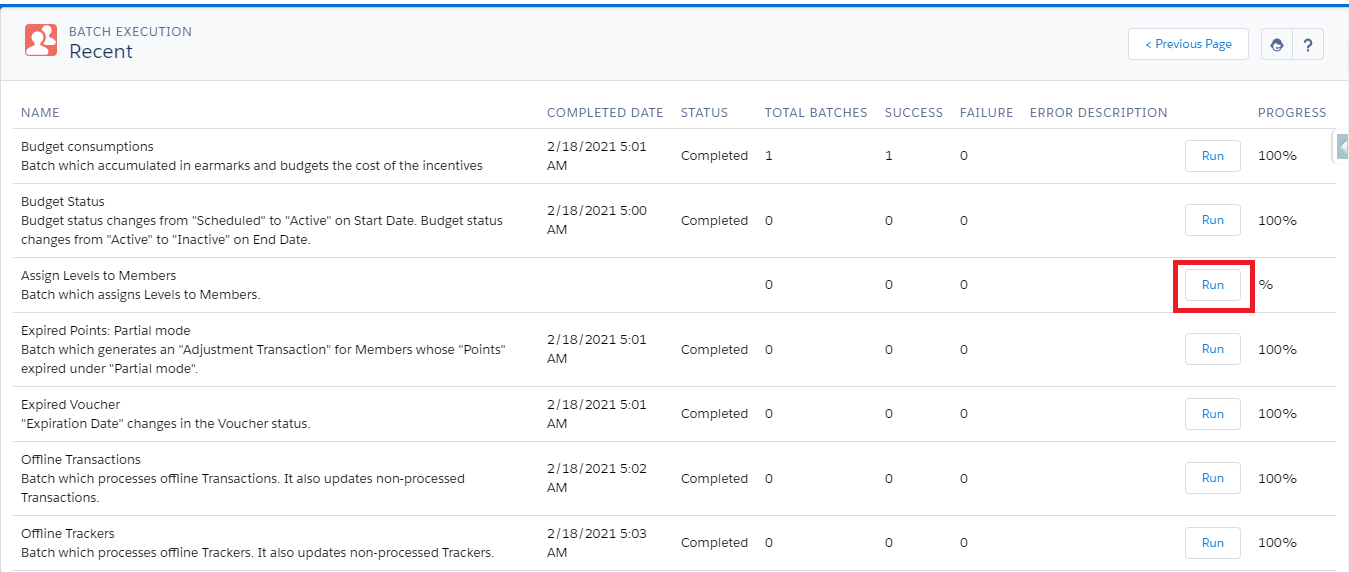
Run Levels to Members Assignment Batch
Updated over 1 year ago